Hong Kong's living landmarks
Old and Valuable Treesand Stonewall Trees
Walk past the stone walls of Central or along Nathan Road in Tsim Sha Tsui, or pause in the shade of a park, and you will see that trees have long been part of Hong Kong's streets. Some banyans push their roots into the cracks between stones and grow down retaining walls; others stand beside busy roads, alongside people and traffic. From where Old and Valuable Trees and Stonewall Trees are and which species they are, to four places each with their own character, we can look again at how this city lives with its trees.
316 of 333 registrations; registration counts, not a count of individual trees
Grouped by the official district field. The three-region comparison follows below.
Published:
Introduction
Hong Kong's trees sometimes find their own way to grow. Chinese Banyans shade streets between high-rise buildings. On old stone walls below the hills, their roots spread across the masonry like a net. In New Territories villages, roots and brick houses can even grow together, forming a familiar part of the landscape.
These tree scenes have different histories and reflect the character of different places. The distribution data show a striking contrast: Stonewall Trees are concentrated on Hong Kong Island, while Old and Valuable Trees are found across Hong Kong Island, Kowloon and the New Territories. Often discussed together, the two categories have different botanical characteristics and growing environments.
The distribution statistics use the 17 April 2026 edition and cover 738 registrations. They are not a census of all trees currently growing in Hong Kong.
Trees in the city
Two kinds of tree, very different distributions
Walking through older districts on Hong Kong Island, you may see banyans growing from masonry retaining walls. This landscape of trees and walls is particularly noticeable in Central and Western District and Wan Chai District. Across Hong Kong, 94.9% of Stonewall Tree registrations are on Hong Kong Island; Kowloon and the New Territories account for the small remainder.
Old and Valuable Trees are more evenly distributed: Hong Kong Island accounts for 40.8%, Kowloon 29.4% and the New Territories 29.8%. Trees in the register can be found in urban parks, roadside planters and rural visitor spots.
Nearly 95% of Hong Kong's Stonewall Trees are on Hong Kong Island
Old and Valuable Trees are spread more evenly; Stonewall Trees are clearly concentrated on Hong Kong Island
OVT = Old and Valuable Tree; SWT = Stonewall Tree. Each category uses its own total.
- Hong Kong Island
- Kowloon
- New Territories
View data table: Distribution in three regions
| Region | OVT registrations | Share of OVT | SWT registrations | Share of SWT |
|---|---|---|---|---|
| Hong Kong Island | 178 | 40.8% | 316 | 94.9% |
| Kowloon | 128 | 29.4% | 12 | 3.6% |
| New Territories | 130 | 29.8% | 5 | 1.5% |
Looking at the 18 districts, Central and Western and Wan Chai together account for 86.2% of Stonewall Tree registrations. Central and Western alone has 298 registrations across both categories, or 40.4% of all registrations. Its walls, slopes, streets and parks bring different tree landscapes into a small urban area.
Trees in the 18 districts: Central and Western stands out
Registered Old and Valuable Trees and Stonewall Trees compared by district
- OVT only
- SWT only
- Both (hatched)
- Central & Western298OVT only 79 · SWT only 193 · both 26
- Wan Chai101OVT only 33 · SWT only 67 · both 1
- Yau Tsim Mong93OVT only 85 · SWT only 6 · both 2
- North50OVT only 50 · SWT only 0 · both 0
- Southern49OVT only 26 · SWT only 21 · both 2
- Sha Tin20OVT only 19 · SWT only 1 · both 0
- Tai Po20OVT only 20 · SWT only 0 · both 0
- Eastern17OVT only 11 · SWT only 6 · both 0
- Sham Shui Po17OVT only 14 · SWT only 3 · both 0
- Kowloon City14OVT only 14 · SWT only 0 · both 0
- Kwai Tsing13OVT only 10 · SWT only 3 · both 0
- Wong Tai Sin10OVT only 9 · SWT only 1 · both 0
- Yuen Long8OVT only 8 · SWT only 0 · both 0
- Tuen Mun8OVT only 8 · SWT only 0 · both 0
- Sai Kung6OVT only 6 · SWT only 0 · both 0
- Islands5OVT only 4 · SWT only 1 · both 0
- Tsuen Wan5OVT only 5 · SWT only 0 · both 0
- Kwun Tong4OVT only 4 · SWT only 0 · both 0
View data table: Registrations in 18 districts
| District | OVT only | SWT only | Both | Total | Share of all |
|---|---|---|---|---|---|
| Central & Western | 79 | 193 | 26 | 298 | 40.4% |
| Wan Chai | 33 | 67 | 1 | 101 | 13.7% |
| Yau Tsim Mong | 85 | 6 | 2 | 93 | 12.6% |
| North | 50 | 0 | 0 | 50 | 6.8% |
| Southern | 26 | 21 | 2 | 49 | 6.6% |
| Sha Tin | 19 | 1 | 0 | 20 | 2.7% |
| Tai Po | 20 | 0 | 0 | 20 | 2.7% |
| Eastern | 11 | 6 | 0 | 17 | 2.3% |
| Sham Shui Po | 14 | 3 | 0 | 17 | 2.3% |
| Kowloon City | 14 | 0 | 0 | 14 | 1.9% |
| Kwai Tsing | 10 | 3 | 0 | 13 | 1.8% |
| Wong Tai Sin | 9 | 1 | 0 | 10 | 1.4% |
| Yuen Long | 8 | 0 | 0 | 8 | 1.1% |
| Tuen Mun | 8 | 0 | 0 | 8 | 1.1% |
| Sai Kung | 6 | 0 | 0 | 6 | 0.8% |
| Islands | 4 | 1 | 0 | 5 | 0.7% |
| Tsuen Wan | 5 | 0 | 0 | 5 | 0.7% |
| Kwun Tong | 4 | 0 | 0 | 4 | 0.5% |
Kowloon presents another scene. Along Nathan Road between Austin Road and Haiphong Road in Tsim Sha Tsui, roadside planters contain 31 Old and Valuable Tree registrations. Nearby Kowloon Park has 40. Both the busy commercial street and the park at the heart of the city have space for trees.
Two identities
One category recognises the tree; the other concerns where it grows
The name “Old and Valuable Tree” may suggest a towering tree hundreds of years old. Since 2004, the Government has selected distinctive trees on unleased Government land within built-up areas and tourist attraction spots in village areas for the register. The five main criteria cover large size, precious or rare species, old age (such as over 100 years), cultural, historical or important commemorative significance, and outstanding form.
Old and Valuable Trees are therefore not all over a century old. The Government also considers health and growing condition, life expectancy and location. A tree may be valued for an exceptional form or particular cultural significance.
Stonewall Trees are associated with Hong Kong's hilly terrain and traditional masonry retaining walls. To meet the definition, the base of the trunk must be within the wall face, with most roots attached to or passing through the wall. Ordinary freestanding walls, concrete walls and concrete walls faced only with stone do not fall into this category.
A registration can belong to both categories. There are 31 such registrations in the data. This is why the category totals cannot simply be added: the categories overlap, while each has its own inclusion criteria.
An Old and Valuable Tree can also be a Stonewall Tree
One category recognises the tree itself; the other relates to where it grows, on a masonry retaining wall
Trees and places
Four familiar tree scenes, four ways of growing
Statistics describe the distribution, but the relationship between trees and the city becomes clearer on particular streets, in parks and in villages. The same species, Chinese Banyan (Ficus microcarpa), can grow on a wall on Hong Kong Island, in a roadside planter in Kowloon or around a brick house in Kam Tin. A Tree Cotton in Hong Kong Park shows a different form.
Forbes Street: banyans on an old stone wall
The retaining wall on Forbes Street in Kennedy Town is a distinctive Stonewall Tree landscape. Chinese Banyan roots extend down the masonry to the foot of the wall. The texture of the stones and the winding roots form a characteristic scene on Hong Kong Island's dense streets.
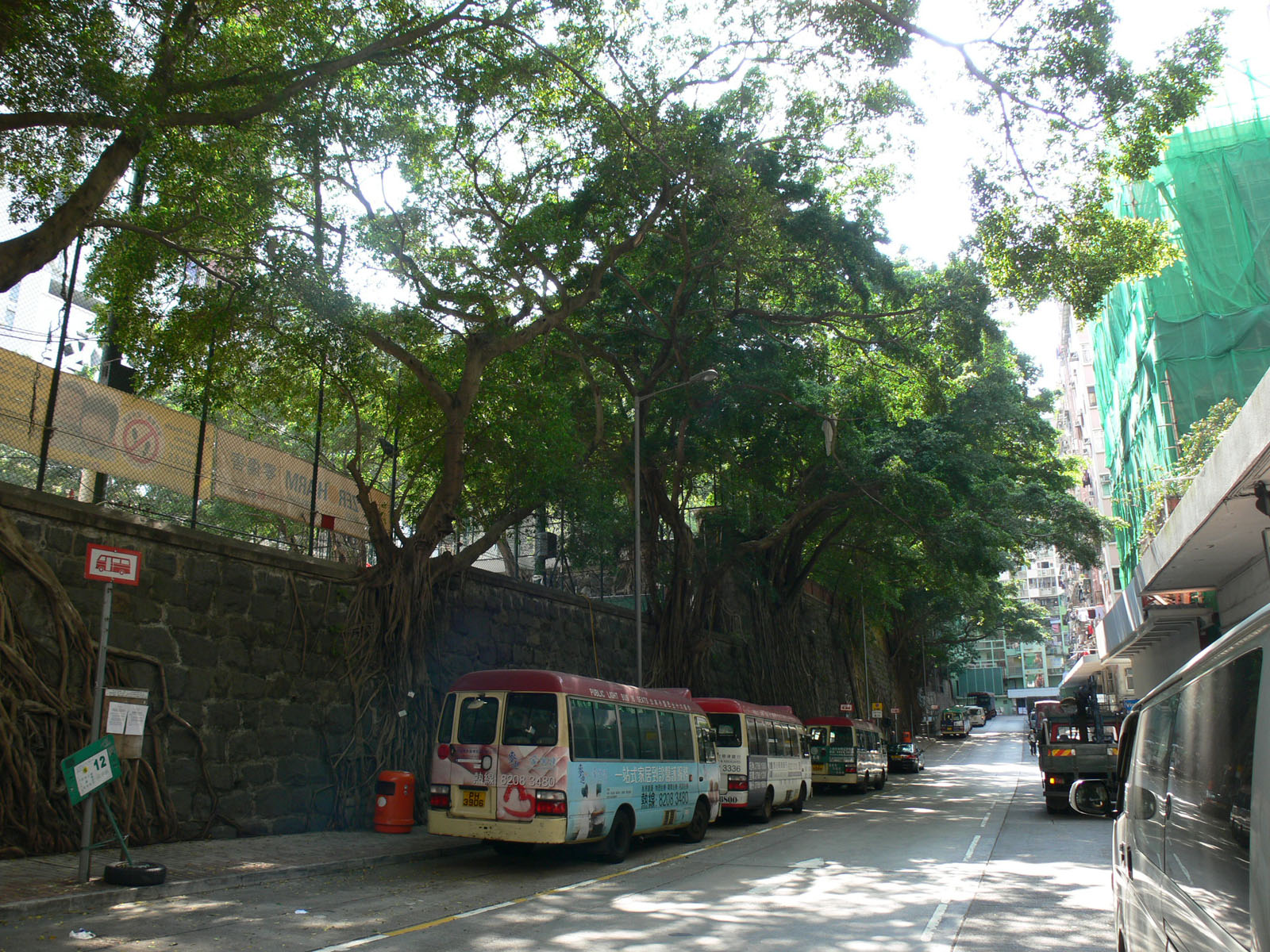
Forbes Street Temporary Playground and King George V Memorial Park are separate places. Together they have 57 Stonewall Tree registrations, including 48 Chinese Banyans. These combined figures show the importance of the species in these wall landscapes.
Traditional masonry retaining walls were built to support slopes and respond to the terrain. As trees take root in their joints, these practical structures acquire a living landscape. Forbes Street's character comes from the lasting relationship between roots, stone walls and hillside streets.
Nathan Road: a green corridor beside a busy street
Nathan Road in Tsim Sha Tsui is busy with pedestrians, shop signs, buses and traffic. Banyan crowns add greenery to the street. In its 2014 account of these trees, the Development Bureau described the roadside banyans as a “green corridor”.
Unlike the trees growing along the wall on Forbes Street, these Chinese Banyans stand in roadside planters. They are the same species in a different setting. The photographed tree, registration LCSD YTM/1, is one example.
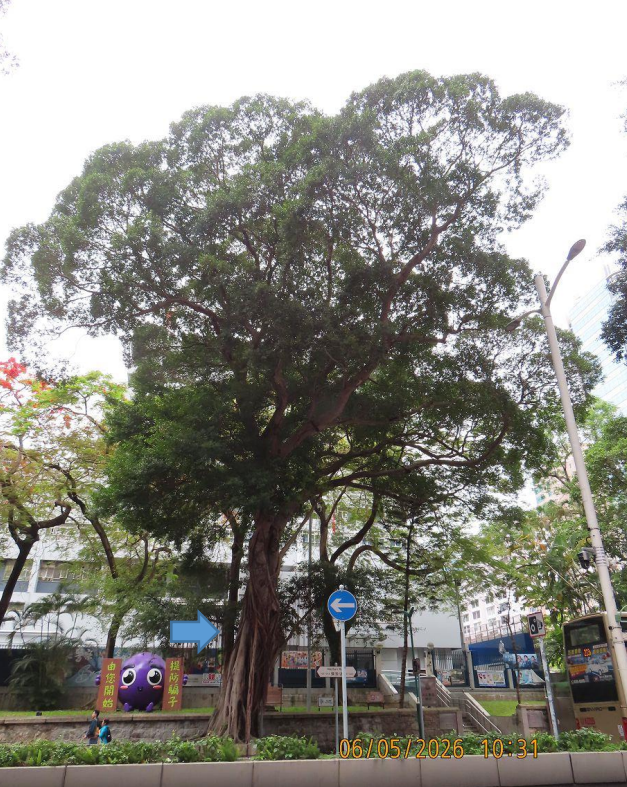
A street's character is made up of many everyday details. Nathan Road's banyans share the street with signs, pavements and commerce, adding a natural outline to dense development. People may not know each tree's registration number, but they can readily recognise its shade.
Kam Tin Tree House: banyan roots and brickwork
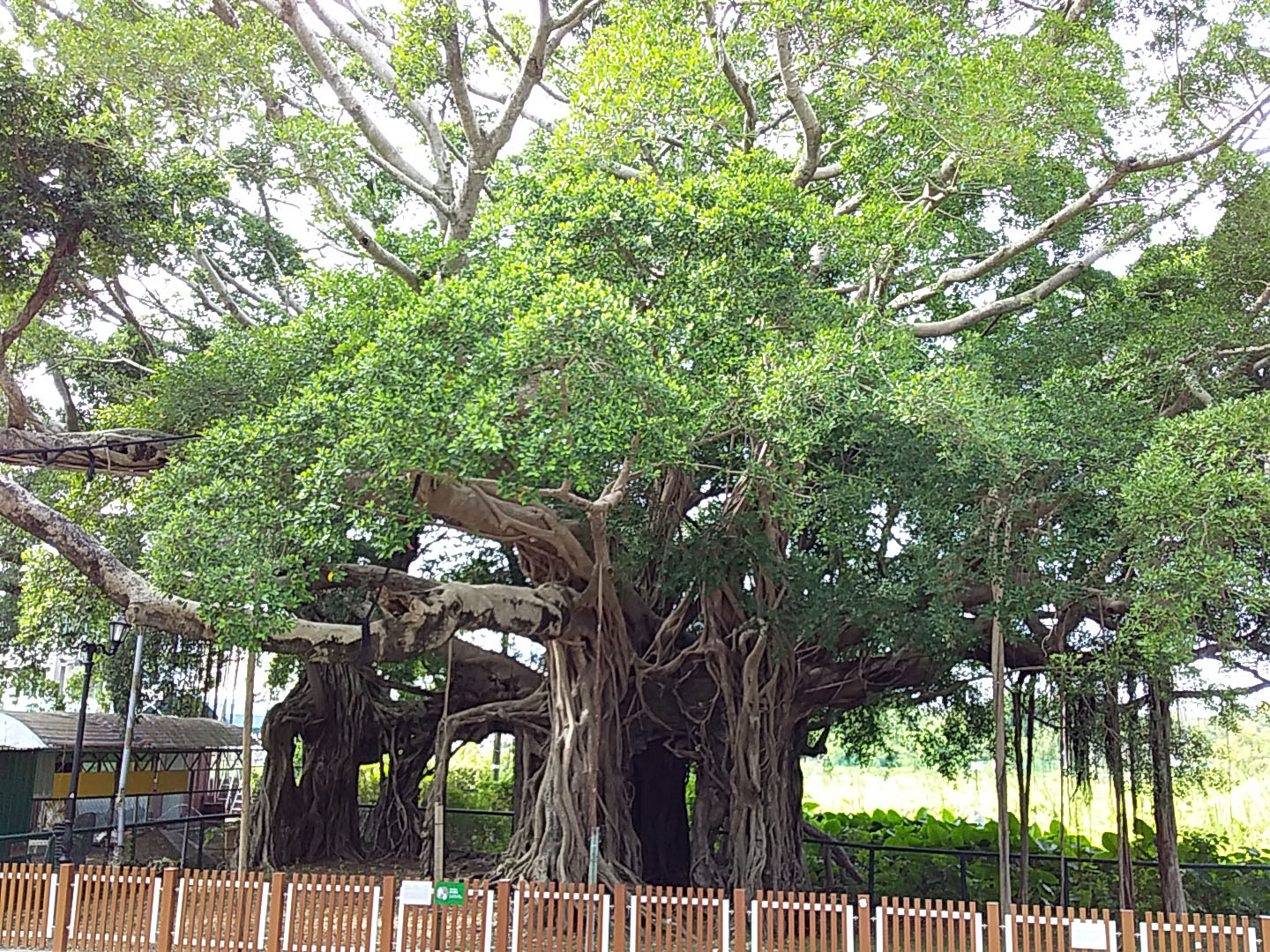
At Shui Mei Village Playground in Kam Tin, Yuen Long, a Chinese Banyan's large roots intertwine with a brick house. Parts of the walls appear enclosed by the roots, creating what is commonly called Kam Tin Tree House. Accounts of the building's original purpose and history differ; its appearance alone cannot establish them.
The intertwined roots and brickwork create a distinctive rural landscape and a representative tree attraction in Kam Tin.
Hong Kong Park: the form of a Tree Cotton
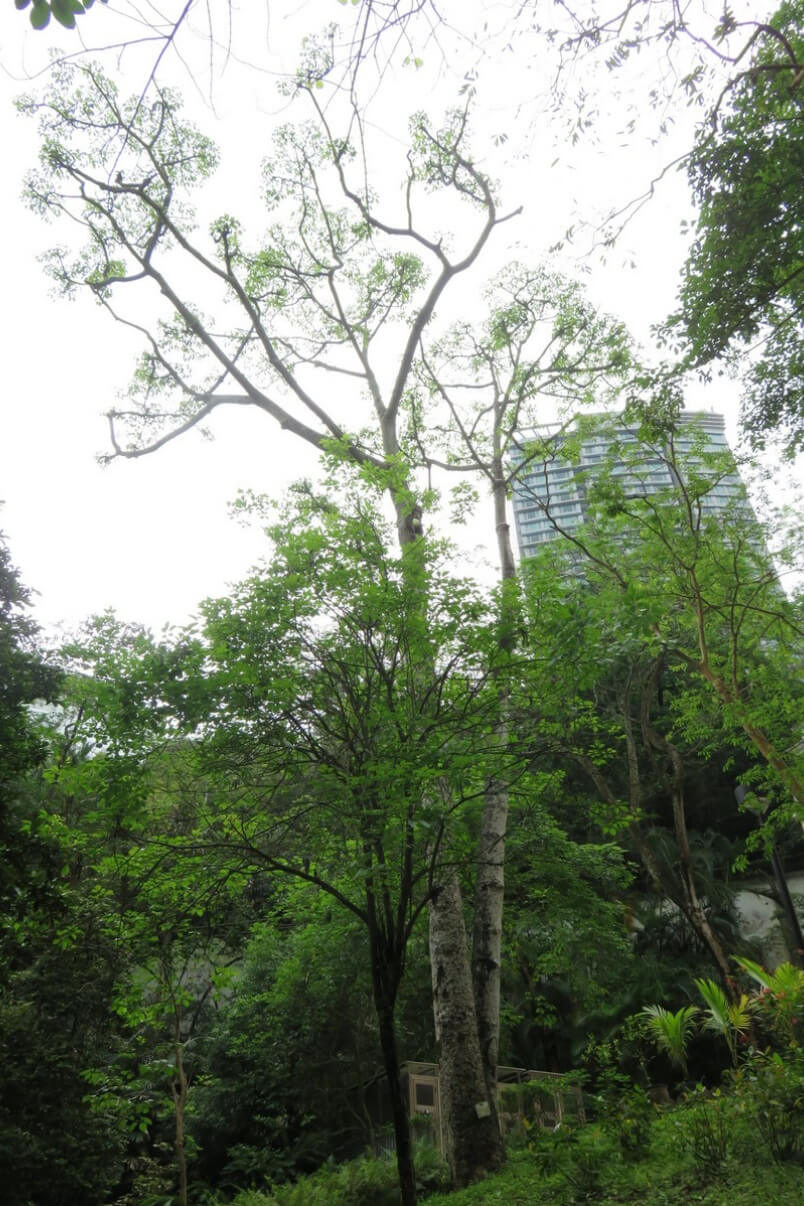
Large trees in Hong Kong may first bring leafy banyans to mind, but the Old and Valuable Tree register is much more varied. A Tree Cotton (Bombax ceiba) in Hong Kong Park is included for its outstanding form, under registration ARCHSD CW/40.
Its shape differs from a banyan's, with a distinctive trunk and striking red flowers when in bloom. This tree adds another form and colour to the story of Old and Valuable Trees.
A public tree election
Hong Kong's favourite Old and Valuable Trees in 2014
Kam Tin Tree House also won public appreciation. The Development Bureau held the “Our Favourite Old and Valuable Trees” online election from 30 May to 12 September 2014. About 4,800 online votes were received, and the results were announced on 15 November. Three entries won in each of four categories, making 12 individual trees or groups. The Chinese Banyan LCSD YL/6 at Kam Tin Tree House came first in the Historical and Cultural Significance category and received the highest number of votes overall. The category winners appear below; the full 12-entry list can also be expanded.
| Category | Tree and location | Historical registration |
|---|---|---|
| Remarkable Form and Size | Silk TreeSau Mau Ping Estate, Kwun Tong | HD/KT/1 |
| Botanical and Ecological Value | West Indies MahoganyHong Kong Cemetery | FEHD WCH/4 |
| Historical and Cultural Significance | Chinese BanyanShui Mei Village Playground, Yuen Long | LCSD YL/6 |
| Contribution in Landscape Setting | India Rubber TreeShing Mun Road (Lower)/ Texaco Road North junction | ARCHSD TW/1 and 2 |
The official results do not give individual vote counts for each tree or group.
View all 12 winning trees and groups
| Rank | Tree and location | Historical registration |
|---|---|---|
| 1 | Silk TreeSau Mau Ping Estate, Kwun Tong | HD/KT/1 |
| 2 | India Rubber TreeLugard Road | LCSD CW/134 |
| 3 | Chinese BanyanSha Tsui Playground, Sai Kung | LCSD SK/7 |
| Rank | Tree and location | Historical registration |
|---|---|---|
| 1 | West Indies MahoganyHong Kong Cemetery | FEHD WCH/4 |
| 2 | Incense TreeKowloon Tsai Park | LCSD KC/15 |
| 3 | Lance-leaved SterculiaMorse Park | LCSD WTS/9 |
| Rank | Tree and location | Historical registration |
|---|---|---|
| 1 | Chinese BanyanShui Mei Village Playground, Yuen Long | LCSD YL/6 |
| 2 | Burmese RosewoodFormer Central Government Offices Compound | CSO CW/1 |
| 3 | Chinese BanyanWu Kai Sha Village, Ma On Shan | LANDSD ST/2 |
| Rank | Tree and location | Historical registration |
|---|---|---|
| 1 | India Rubber TreeShing Mun Road (Lower)/ Texaco Road North junction | ARCHSD TW/1 and 2 |
| 2 | Chinese BanyanKing George V Memorial Park | ARCHSD CW/11–23 |
| 3 | Chinese BanyanPark Lane, Nathan Road Shopper’s Boulevard | LCSD YTM/1–7, 12–30 and 32–39 |
Source: Government announcement of 15 November 2014 and official English annex. Names, locations and registrations are those in the 2014 results.
Species and growth
Why are most Stonewall Trees figs?
Chinese Banyans recur in the tree landscapes from Forbes Street to Kam Tin. The species data support that familiarity: Stonewall Tree registrations cover 11 species, 97.0% belong to the genus Ficus, and Ficus microcarpa alone accounts for 73.9%.
Old and Valuable Trees cover a more varied 69 species. Chinese Banyans remain common at 48.4%. The register also includes 44 Cinnamomum camphora registrations and 19 Ficus elastica registrations, while 39 species each have only one registration. Hong Kong Park's Tree Cotton is one vivid example of the wider range.
The Chinese banyan dominates Hong Kong's stone walls
Stonewall Trees are almost all figs (Ficus); Old and Valuable Trees include many more species
OVT = Old and Valuable Tree; SWT = Stonewall Tree. Each category uses its own total.
- Ficus microcarpa
- Ficus virens (syn. Ficus virens var. sublanceolata)
- Ficus subpisocarpa
- Cinnamomum camphora
- Ficus elastica
- Other species
All Ficus species combined: OVT 62.2%; SWT 97.0%.
View data table: Species composition (official scientific names)
| Species | OVT registrations | Share of OVT | SWT registrations | Share of SWT |
|---|---|---|---|---|
| Ficus microcarpa | 211 | 48.4% | 246 | 73.9% |
| Ficus virens (syn. Ficus virens var. sublanceolata) | 29 | 6.7% | 53 | 15.9% |
| Ficus subpisocarpa | 0 | 0.0% | 21 | 6.3% |
| Cinnamomum camphora | 44 | 10.1% | 0 | 0.0% |
| Ficus elastica | 19 | 4.4% | 0 | 0.0% |
| Other species | 133 | 30.5% | 13 | 3.9% |
The ability of figs to grow on stone walls relates to their reproduction and root systems. Species such as Ficus microcarpa, Ficus subpisocarpa and Ficus virens have a strangling growth habit and can attach to and grow on vertical masonry surfaces.
The process often begins with a seed. Birds or bats eat fig fruits and carry their seeds elsewhere. A seed that lands in a joint between stones may germinate in suitable conditions. Young roots gradually enter the joints and reach soil behind the wall, where they obtain water and nutrients. As the roots grow, a network develops across the wall face.
How does a seed grow into a banyan on a stone wall?
A seed lands in a crack and sprouts; its roots grow through the joints of the wall and draw water and nutrients from the soil behind it
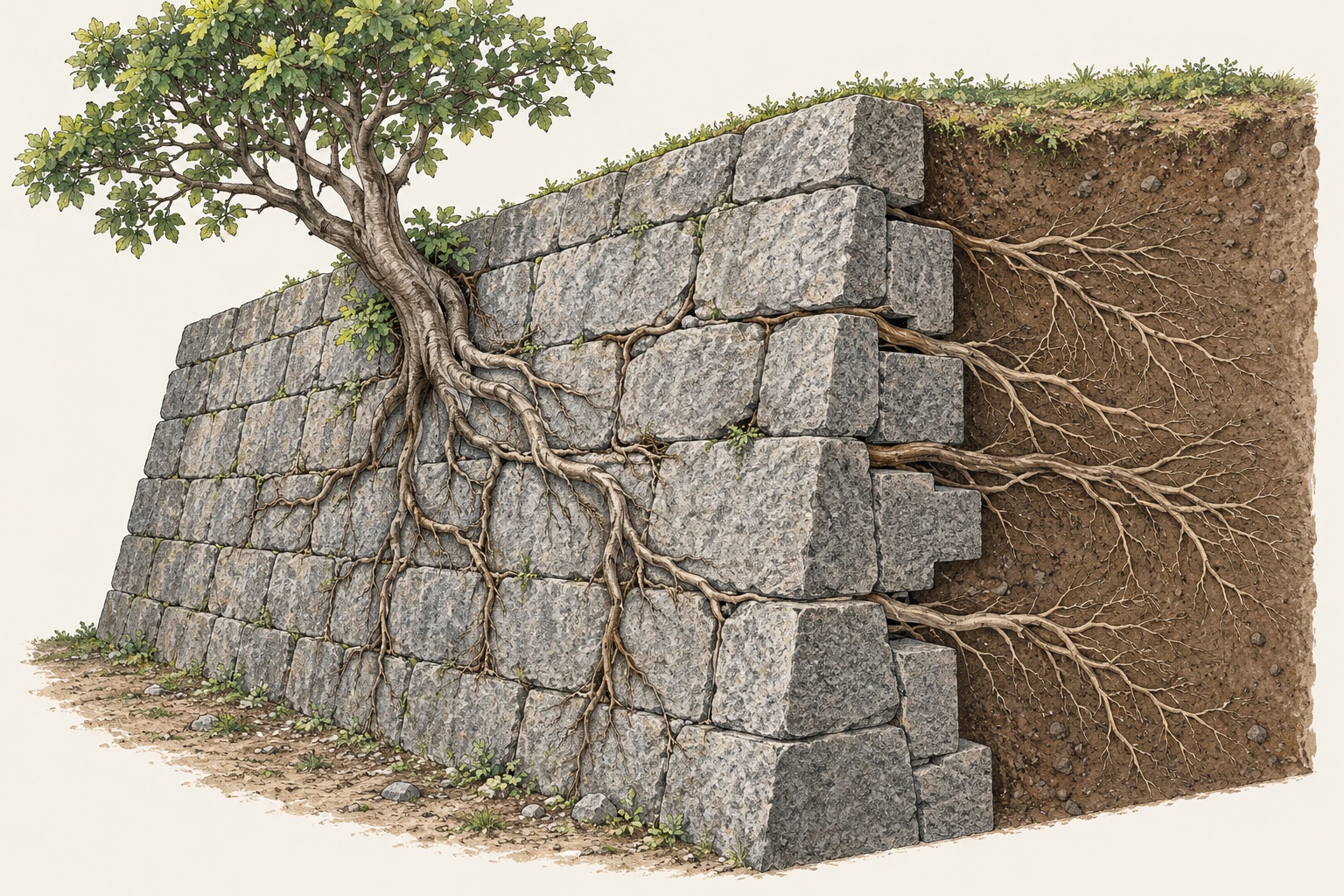
- Roots on the wall face
- Through joints between stones
- Into the soil behind the wall
Standing in front of a wall, we can see roots spreading across its face but may not see their connection to soil behind it. The relationship between the tree, the wall, its joints and the soil is intricate.
These retaining walls represent Hong Kong's traditional masonry construction, and their trees are part of the urban landscape. Caring for Stonewall Trees must take account of the structural conditions of both tree and wall; their relationship is more complex than the visible roots alone suggest.
Hong Kong in the shade
Look again next time you pass
Hong Kong's cityscape keeps changing, while some trees have long been bound to particular places. Banyan roots spread across Forbes Street's old walls; Nathan Road's Chinese Banyans line a busy street; Kam Tin Tree House brings a tree together with village architecture; and Hong Kong Park's Tree Cotton shows a different form. Next time you pass, look beyond the buildings, shops and signs to the trees beside them. Details among their branches and roots are another way to understand Hong Kong.
Data, with context
Sources and method
Data edition: 17 April 2026 (20260417v3)
Retrieved: 11 October 2026, 16:31 Hong Kong time
Underlying snapshot checked: 11 October 2026
Official update frequency: about every six months
Distribution and species statistics use the Development Bureau's Old and Valuable Trees and Stonewall Trees dataset. Definitions come from the Register of Old and Valuable Trees, the Tree Register and the Guidelines for Management of Stonewall Trees (December 2013). The individual examples also draw on the Development Bureau's 10 August 2014 account and the 2014 election announcement and English winners annex. The approximately 4,800 votes are the overall online vote count; the official annex gives no individual vote counts. Each official photograph is credited in its caption.
The fixed snapshot contains 738 registrations: 436 in the OVT category, 333 in the SWT category and 31 in both. Registrations are not a count of unique surviving trees. The OVT register mainly covers unleased Government land within built-up areas and tourist attraction spots in village areas; country parks are excluded. These figures are not a Hong Kong-wide tree census. The source edition and retrieval dates have not been reset for this translation.
Scientific names in the charts are the official dataset's Species_EN values. Common names and historical locations in the election table come from the official English annex. Other common names are checked against the Development Bureau's bilingual tree labels and LCSD's Hong Kong Park plant information. English wording and names checked on 26 October 2026; this is not a new data retrieval.
The shared CSV downloads retain their published field names and original Chinese region/species labels; district and scientific-name fields also include English.
Intellectual property rights in the source data belong to the Hong Kong SAR Government and the relevant data providers (Development Bureau). Applicable terms: DATA.GOV.HK Terms and Conditions. Values compiled or calculated by Agoodeal are not official figures.
Information is for general reference only and is not a recommendation or a basis for an individual decision; verify important matters independently. For limitation of liability, seeData use and disclaimer.